
self help book recs
it's time to meet your third parent

When our perspective changes, our life changes. A book, sentence or idea that opens our mind and heart is one of the most powerful forces on the planet.
But psychology, theology, philosophy, spirituality, health and wellness books can sometimes feel too doctrinarian and/or deluded. Because doctors, therapists, philosophers, gurus, healers, shamans, preachers, witches, coaches and teachers are still human. So their work is still accompanied by all the limitations, flaws and judgements that accompany anyone sharing their ideas - and this is the beauty and the tragedy of the self-help section.
Nevertheless, the right idea at the right time - even from the ‘wrong’ person or shared in the ‘wrong’ way - can be exactly what we need.
Yet the act of entering the realm of self-help can feel like a confession in-and-of itself. A confession that says, ‘heyyyy, I’m interested in meeee and I need helppp.’ It takes vulnerability and shamelessness to go there, but the rewards can be infinite. Because while knowledge might be power; self-knowledge is sovereignty.
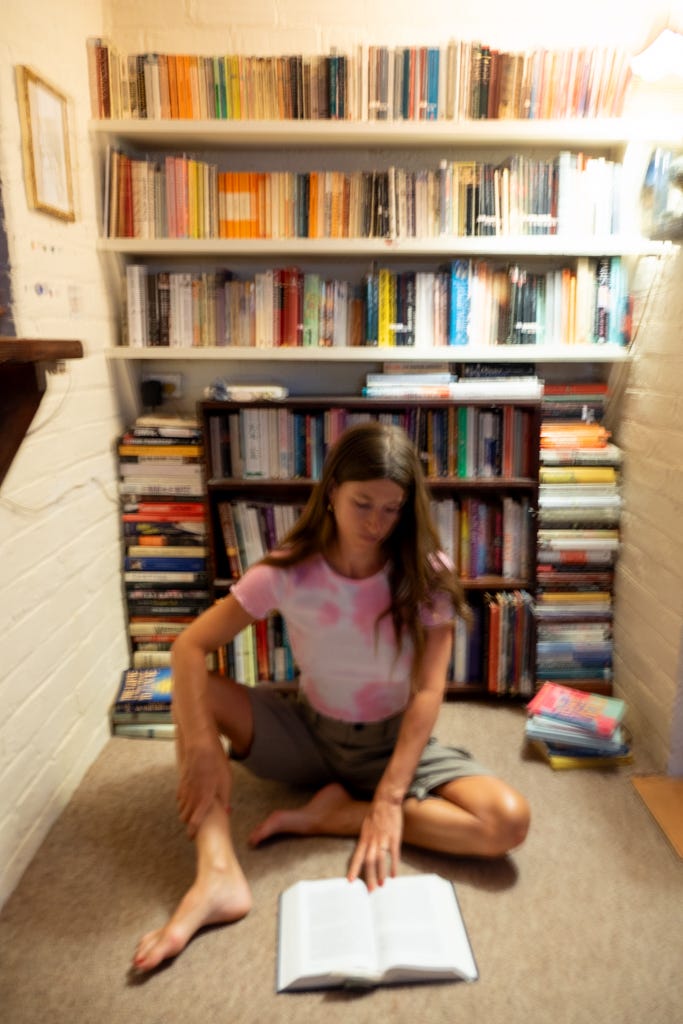
I grew up largely without religion. I went to a non-denominational school. I lived in a one-storey, Victorian house, surrounded by adults, classical literature, crime fiction, entertainment mags, CDs, biographies, VHS tapes, autobiographies, DVDs and theory. My parents were and are film and TV critics.
Every room in the house bar the bathrooms and kitchen had floor-to-ceiling bookshelves that were full. And, tbh, the cookbook shelf was bending under the weight of Donna Hay, Stanley Tucci, Gabriel Gate, Deliah Smith, Women’s Weekly, Jamie Oliver, Ainsley Harriott and Karen Martini.
Exposure to the spoils of the intelligentsia shaped me. But it has its limitations; the intellect can only offer and answer for so much. A longing for spirit, for soul, and for God, and a conscious connection to all that is, was consistent, and unwavering. I wanted to see into the unseen.
So, after I was given a bookshop voucher by my aunty for my eighteenth birthday, I wandered into the self-help section, and I never looked back. There, I was introduced to the magic of the mind/body connection; the shadows of the unconscious; the tricks of the ego; the spirituality of sex; the tools to heal a broken heart; the power of intuition; the quantum field.
This list is comprised of 12ish self-help books that have changed my life and perspective. I’ve included short extracts from each, because whenever I’m considering a book, I open to a random page to see if what’s written resonates - and I did this for each book with you in mind.
Some of the authors are recounting what the angels have said to them; some are well-researched doctors; some of the authors are recounting what Christ has said to them and they’re well-researched doctors; some are heretics; some are widely respected bestsellers.
Help yourself 💗
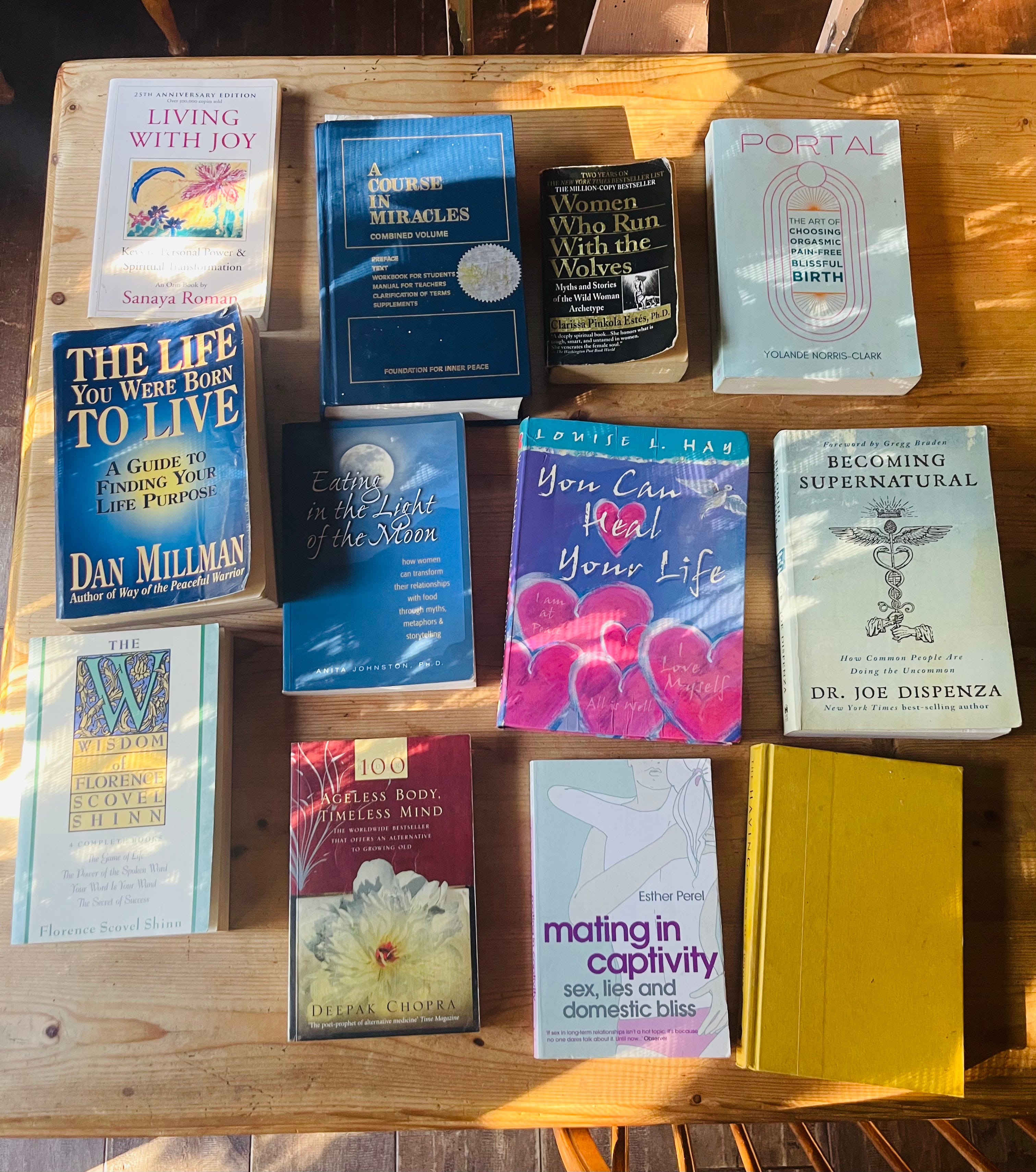
1. Living with Joy by Sanaya Roman 🏆
“When things are not going well in your life, sometimes you gather motivation and energy to change them by becoming angry or choosing pain. It need not be difficult to leave the old and embrace the new. If you start thinking of what you want, how you would like your life to be, you begin easily and automatically to draw the new to yourself. If you want something and it can only come when another person changes or acts differently, then you do not have power or control over that. You only have power or control over your own emotions and reactions.” P176
Living with Joy is my number one pick because of how many times I’ve read and re-read it, which would be impossible to count. It’s been beside my bed, to the beach, to the backyard, by the pool, on the train, and interstate. It traverses complex day-to-day challenges in a simple way and shares insight with a warmth and an ease that always leaves me feeling uplifted and free.
In Living with Joy Sanaya Roman channels messages told to her by ‘being of light’ Orin. The book is part of a series of Orin books by Roman, all of which I’ve read many times: Personal Power Through Awareness, Soul Love and Spiritual Growth. Each book is accessible, and wise, but LWJ is the most relatable. The others are good if you want to gnaw on more esoteric challenges - like tapping into higher frequencies and tuning into soul communication - but the perspective offered in LWJ is revelatory and applicable everyday, in every moment.
Orin and Roman’s essential argument in LWJ is: if we consciously choose joy, and if we are awake to ourselves and to what’s going on around us, we can create a joyful life. It’s a simple message that conjures contentment rather than striving. And, often, that’s exactly what I need.
2. You Can Heal Your Life by Louise Hay 👑
“I believe we create every so-called illness in our body. The body, like everything else in life, is a mirror of our inner thoughts and beliefs. The body is always talking to us, if we will only take the time to listen. Every cell within your body responds to every single thought you think and every word you speak.
Continuous modes of thinking and speaking produce body behaviours and postures and ‘eases’ or ‘dis-eases’. The person who has a permanently scowling face did not produce that by having joyous, loving thoughts. Older people’s faces and bodies show so clearly a lifetime of thinking patterns. How will you look when you are elderly?” P151
Louise Hay is the grand dame of the self-help section. The publishing house she founded, Hay House, has published pretty much every self-help author you can name. You Can Heal Your Life is her seminal text and I refer to it frequently. It’s a confronting and magical read.
Hay believes the most important thing we can do is love ourselves. She argues that this has the power to heal us and those around us. She also contends that our emotional and spiritual states create our physical reality - and while she’s not the first or the only person to state this, she does so in a loving, straightforward way.
Hay uses accessible language, and positive affirmations, which can seem too easy at times, but their ramifications are extensive. Because when you really let the meaning of an affirmation sink in, like, if you really connect with a phrase as basic as, Life is for me, for example, it’s hard to deny the feel-good vibes that follow. And her affirmations have definitely helped me to heal knee pain, period pain, IBS, and neck tension, through consciously cultivating forgiveness, deeper trust, or whatever the physical symptom was signifying, according to her.
YCHYL also includes ‘The List’ which is Hay’s alphabetical breakdown of physical ‘dis-eases’ - from ‘Abdominal Cramps’ to ‘Yeast Infections’ - and their emotional, spiritual, and psychological ‘probable causes’ as well as the ‘new thought patterns’ to employ in order to assist in healing them. For instance, a rash’s probable cause is: ‘irritation over delays. Babyish way to get attention’ and it’s new thought pattern is: I love and approve of myself. I am at peace with the process of life. Again, insultingly simple, but potent af.
3. Becoming Supernatural by Dr. Joe Dispenza 🧠
“To separate two atoms, it takes energy. By the same means, if your attention and energy are bound to the same people, places, and things in the outside, physical world, you can understand that it’s going to take energy and effort to break those bonds when you’re in meditation. This begs the question: how much of your creative energy is tied up in guilt, hatred, resentment, lack or fear? The truth is that you could be using all that energy to re-create a new destiny.
To do that, you’re going to have to get beyond all of those things in your outer world by taking your attention off them. That’s why we use meditation as the model to change our internal state. This allows us to break from our associations to everybody, everyone, everything, everywhere, and every time, long enough to journey within.” P50
Dispenza’s work - and meditation of any kind - is rebellious. We’re constantly being inundated by information, distraction, and expectation. So choosing to tune out, to say no, to stop, to be quiet, to reflect, and to take a break, is badass. In other words, it’s no longer a given that you’re going to have time to yourself today - if you want it, you’re going to have to take it.
I’ve tried many different meditation techniques and styles over the years - Zen, Buddhist, transcendental, angelic, breath-focused, visualisation, gratitude, mindfulness - but Dispenza’s have stuck.
Becoming Supernatural is his best book, because it focuses solely on cultivating an awareness of what he calls ‘coherence’ and a connection to ‘source’ that can alter our consciousness and our sense of our power and place in the universe. It opened me up in ways that no other modality has.
The tools and explanations Dispenza offers are digestible and enjoyable to read. He also provides tonnes of studies, surveys, and findings from extensive research that he and other scientists have done on the mind, and heart, and how their ‘coherence’, or lack of it, impacts our moods, hormones, behaviours, hopes, dreams, habits and relationships.
Dispenza never states this explicitly, but I find most of his guidance to essentially be instructing us to die before we die. One of the mantras he repeats in the book and employs in his guided meditations (which I do through YouTube channel Master Your Mind) is ‘become nobody, nowhere, in no place, at no time’. Get ready for a rebirth.
4. The Life You Were Born To Live by Dan Millman 🔮
“People from all walks of life share an innate drive for meaning, direction and purpose. This drive to understand our life purpose seems as important to our psychological growth as eating is to our biological survival.
Although many of us don’t consciously recognize or acknowledge that we even have a specific life purpose, our subconscious knows what we are here to do; it reaches out to us, sending messages through our dreams, intuitions and innermost longings. The call of our destiny manifests as our deepest drives and abilities - the hidden forces behind our personality. These drives shape our career and our relationships, and influence the quality and direction of our life.” Pxi
I was life-modelling for a painter when she stopped in the middle of a sitting and asked if I was a numerologist. Two years prior, a psychic had told me that I was a numerologist in a past life, and that if I got into numerology in this life, it would help me and those around me. I explained this to the artist and she brought out Millman’s book, The Life You Were Born to Live. We worked out my numerology number, I read my chapter, and wept.
Numerology is thought to be an ancient, Pythagorean thing. Some numerological systems go from 1-9, Millman’s Life-Purpose System goes from 1-12, because he believes that 10, 11 and 12 hold unique energies and, as an 11, I agree.
To work out your number, you add together the day, month and year of your birth (d+d+m+m+y+y+y+y) and from that you get another number. For instance, I get 38, which can then be reduced to 3+8, which is 11. Millman has a chapter for 38/11s and this is the one that made me weep; the feeling of recognition was overwhelming.
Since, numerology has become a powerful navigational tool in my life and relationships. My partner and I spend a lot of time working out everyone we know’s numbers - and even the numbers of those we don’t know - because it allows us to see patterns in all different kinds of people. And they can be uncanny. Like, 34/7s and 36/9s make great actors socially and/or professionally; 32/5s are visionaries, but they’re very susceptible to the opinions of others; 37/10s are powerful, but their desire to be seen as a ‘good student’ can get in their way of their leadership; etc.
I love astrology, too. Tbh, the least effective diagnostic tools I’ve come across are the ones that are dependent upon behavioural indicators, which can change depending upon a person’s age, mood, background, trauma, hormones, sex life, relationship and work status. There’s something solid yet magical about working with planets, times and dates - and Millman’s book is a testament to this.
5. Women Who Run with the Wolves by Dr. Clarissa Pinkola Estés 🐺
“To follow a lifeless value system causes loss of soul-linkage in the extreme. Regardless of collective affiliations or influence, our challenge on behalf of the wild soul and our creative spirit is to not merge with any collective, but to distinguish ourselves from those who surround us, building bridges back to them as we choose. We decide which bridges will become strong and well travelled, and which will remain sketchy and empty. And the collectives we favour with relationship will be those that offer the most support for our soul and creative life…
If a woman works at a university, she is in an academic collective. She is not to merge with whatever this collective environ may put forth, but add her own special flavour to it. As an integral creature, unless she has created other strong things in her life to offset this, she cannot afford to deteriorate into a one-sided, peevish, ‘I do my job, go home, come back…’ kind of person.” P244
Reading Women Who Run with the Wolves is like attending daily sessions with the hardest-core Jungian psychoanalyst of a generation for less than $30.
It’s about reclaiming the wild self and it’s for men and women. Estés often refers to women when she’s elucidating upon and examining different stories and folk tales, but her crazy-adept psychoanalysis provides a bounty of treasures for every type of reader. So, whoever you are, if you want to delve deep into the destructive, domesticated patterns of your psyche, their archetypal origins, and how to simultaneously embrace and liberate yourself from them - then WWRWTW is the book for you.
Over the last decade, I’ve read it slowly, twice, and it has shaken my sense of self to the core on both occasions. It’s like undergoing surgery, repeatedly, then entering into a healing process, again. I’ll read a paragraph, or sentence, put the book down, sip a tea, eat some chocolate, look at the sky, read the aforementioned paragraph or sentence again, get up, feverishly attempt to explain it to my partner, fail, hate myself, then forgive myself, before leaving the book for a day, or a month, while continuing to ponder whatever it was that I read, then returning to it, and diving in again.
Estés retells and unpacks many well-told tales to highlight how story can unlock power and meaning: The Ugly Duckling, The Red Shoes, Hymn for the Wild Man: Manawee, Skeleton Woman, The Little Match Girl, Sealskin, Soulskin and more. And, through analysing these stories, Estés taps into universal, primal truths about belonging, nourishment, ambition, curiosity, and intimacy.
She also reveals how whatever seemingly innocuous challenges we might be facing are ancient. Then, she gives us space to consider who we are, who we want to be and how to go about it. WWRWTW is wild, soulful reading.
6. Mating in Captivity by Dr. Esther Perel 🫦
“Loving another without losing ourselves is the central dilemma of intimacy. Our ability to negotiate the dual needs for connection and autonomy stems from what we learned as children, and often takes a lifetime of practise. It affects not only how we love but also how we make love. Erotic intimacy holds the double promise of finding oneself and losing oneself. It is an experience of merging and of total self-absorption, of mutuality and selfishness. To be inside another and inside ourselves at the same time is a double stance that borders on the mystical. The momentary oneness we feel with our beloved grows out of our ability to acknowledge indissoluble separateness. In order to be one, you must first be two.” P124
I read Mating in Captivity three years into my now eleven-year-long relationship and thank godddd. The longest relationship I’d been in prior to this one was two-years, so at the three-year mark, I went on a rampage. I started reading books like Tantra by Osho, Men are from Mars and Women are from Venus by John Gray, and Getting the Love You Want and Keeping the Love You Find by Dr. Harville Hendrix, because I felt out of my depth, lol. Suffice to say, Perel’s book outshone the rest.
I was drawn to Mating in Captivity after listening to Perel’s infamous TED talk, Rethinking Infidelity. Her ability to weave an intricate web from the dualities of intimacy is totally inspired. And the philosophical outlook she takes on highly-charged topics is refreshing.
In MIC, Perel makes a slew of genius, loving observations. The two that have really stayed with me are 1) maintaining a zest for a life as an individual allows us to maintain zesty relationships and 2) our beloveds are unknown to us, no matter how long we’ve been with them.
However, in a long-term relationship, it can be tempting to take our partners for granted and/or to make assumptions about them. And, as Perel points out, this temptation can destroy the life force of a relationship and its capacity for growth. But, rather than insisting we throw away our need for comfort and security altogether, which would be inhumane, Perel encourages steadiness and adventure. Because our intimate relationships needn’t be either/or - it’s far better for them to be and/and.
7. Portal: The Art of Choosing Orgasmic, Pain-free, Blissful Birth by Yolande Norris-Clark 💫
“The regularity and reflexiveness with which my proposition that every woman is mighty and masterful is taken as an insult and a provocation is both fascinating and disturbing - but also, sadly, predictable. I wonder if perhaps there is an element to the issue of intense defensiveness of the prevailing response that relates to the ongoing, pervasive themes of both sexual repression and the accompanying lack of sexual boundaries in contemporary culture. Not only do many women unconsciously see themselves as undeserving of pleasure, but as undeserving of power as well (not to mention confused as to what power truly comprises).
Birth is the completion of the sexual cycle - the apotheosis of sexual fulfilment. It is as normal, natural and biologically and spiritually ordained for birth to be as exquisitely blissful and orgasmic as sex can be (and hopefully is) for all of us… birth and sex are on an unwavering, inarguable, self-evident continuum.” P126
Yolande Norris-Clark is a pioneer of the free birth movement. Her book, Portal, roams the personal, scientific, political, philosophical, critical and spiritual - and it is an awakening read.
Norris-Clark views birth as a transformative, psychedelic, ancient, physiological adventure that functions best without any form of medical intervention. She argues that the more we honour the natural and inherent machinations of birth, the more miraculous, and safe, the experience of it can be. And she’s come to this conclusion through the birthing of her many children; through working with thousands of women as a birth keeper; and through reflecting upon what she convincingly argues to be the systems of abuse, oppression, and intrusion, endorsed by modern obstetrics and medical midwifery.
Norris-Clark started on the free birthing path at 19 when she experienced a miscarriage shortly after undergoing a vaginal ultrasound she didn’t want. And while she recognises she’ll never know for sure that the two events were interrelated, she has a bad feeling, and that feeling was a part of what’s led to her extensive body of work, to her ten children born outside the medical industrial complex, and to Portal.
At the time of writing, Norris-Clark is 44 and pregnant with her eleventh baby. Portal documents the emergence of Norris-Clark’s ninth baby, Helio, who she claims came into this world orgasmically, free of pain and torment, which was different from her previous births - even if each one was metamorphic in its own way.
In Portal, it is an honour to read Norris-Clark tackling the primal with the intellectual and emerging the victor. Her capacity to pierce through confusion, fear, and complexity is disarming, and hilarious. She’s my favourite heretic.
8. Ageless Body, Timeless Mind by Dr. Deepak Chopra 🌹
“Life’s uncertainty makes constant demands on everyone’s coping mechanisms. There are basically two ways to cope with uncertainty - acceptance and resistance. Acceptance means that you allow events to unfold around you and react to them spontaneously, without suppression. Resistance means that you try to change events from what they really are and react to them with familiar, safe responses. Acceptance is healthy because it permits you to clear any stress as soon as it occurs; resistance is unhealthy because it builds up residues of frustration, false expectations, and unfulfilled desires.” P173
Ageless Body, Timeless Mind was first published in 1993 and I’m pretty sure it was Deepak Chopra’s first bestseller. He’s had many. But ABTM is a classic. I read it for the first time in 2009 and it made the process of deterioration and ‘dis-ease’ that’s assumed to accompany aging seem like a choice rather than an inevitability.
Chopra argues that we’ve been dealing with ‘aging’ bodies our entire lives and that there’s no reason for the process to all of a sudden become heinous, scary, or overwhelming. Instead, it can be liberating.
He presents scientific research alongside ancient, mind-body wisdom as he explores the power of our psychology and emotions to shape our bodies. And as I was flipping through ABTM again, I was searching for a study I remember Chopra including, the findings of which have haunted me ever since, but I couldn’t spot it(!) so I’ll roughly sum it up (and if you read the book and find it let me knowww).
Chopra references a study where a bunch of 60+ year old men with heart disease were put into two groups: one was given a new diet, exercise regime, and lifestyle. No more ciggies, no more alcohol, lots of fresh produce, good quality meat, portion control, and regular monitoring from specialists. The second group wasn’t required to make any changes. They could carry on with their ciggies and Twinkies.
The study extended across a span of years, I think, and, by the end, there were more deaths in the first group. The resulting theory being that the men forced to change their lifestyles suddenly, and drastically, and who were robbed of what gave them pleasure, were less resilient overall, because it wasn’t their choice. Sure, they chose to do the experiment, but they were no longer in charge of their day-to-day lives - and it literally broke their hearts.
All of which is to say that ABTM is a potent reminder of the importance of crafting a life that is aligned with our values, beliefs, pleasures and passions - and it’s an evocative read.
9. Eating in the Light of the Moon by Dr. Anita Johnston 🌙
&
Women, Food & God by Geneen Roth 🍇
“It is essential to recognise that you have within yourself the capacity to develop a strong inner mother, one that can provide you with the nourishment and guidance you need, not only to survive, but also to grow and flourish.
How do you do this? By treating yourself the way you would treat a child whom you care for very much…. This means not judging your feelings or criticizing yourself for feeling jealous, hurt or annoyed. Allow yourself the space to experience your feelings fully so you can learn from them.
This means following your intuition rather than blindly accepting others’ perceptions or automatically doing what others want you to do in order to please them. It requires a certain vigilance so that you are constantly checking in with yourself, asking yourself, ‘how does this feel? Do I really want to do this?’” P81 of Eating in the Light of the Moon
I’ve put these two incredible books together because it’s thematically appropriate to do so - they both explore food, womanhood and nourishment - but also because, many moons ago, I loaned Women, Food and God to a friend who had a housemate that’d become ‘scary skinny’ overnight, pre-Ozempic, and they were concerned about her, and wanted to give her this book to read, and I never got it back.
Suffice to say, I hope it was as revelatory for her as it was for me. Although, I doubt she ever would’ve read it if she wasn’t drawn to reading it of her own volition, because no one vibes off unsolicited advice, intrusion, or the possibility of competitiveness being thinly veiled as ‘concern’, but I digress.
Women, Food and God and Eating in the Light of the Moon are remarkable reads if your relationship to food has become destructive, and you know it, and you’re ready to do something about it, and to evolve.
Johnston and Roth explore what food means to us and why it can become so loaded. They look beyond calories, nutrients, and physical input-and-output, into what food symbolises: its emotional, historical and spiritual weight. They also manage to celebrate the pleasure, sense of connection, and ritual that food offers, along with all of its delicious scents, tastes, colours, textures and flavours, as they encourage the creation of a more mindful, intuitive and sacred relationship to it.
Because, as a food behavioural psychologist once told me, having a destructive relationship with food can be the hardest addiction to overcome, because you still have to eat. Technically, we can survive without cocaine and alcohol. But there’s no escaping food. There’s no living without it. Which is why it’s crucial to take the relationship that we have with it seriously, and to ensure that it works for us, rather than against us.
10. The Game of Life & How to Play It & its sequel Your Word is Your Wand by Florence Scovel Shinn 🪄
“One of the greatest messages given to the race through the scriptures is that God is man’s supply and that man can release, through his spoken word, all that belongs to him by divine right. He must, however, have perfect faith in his spoken word. Isiah said, ‘My word shall not return unto me void, but shall accomplish that where unto it is sent.’ We know now, that words and thoughts are a tremendous vibratory force, ever moulding man’s body and affairs.” P11 of The Game of Life and How to Play It
The tone of Florence Scovel Shinn’s work seems to come straight out of the 1920s. It is unflinching. It’s as if the second industrial revolution hardened the outlook of even the most esoteric and spiritually inclined. She is insistent, emphatic, and unapologetic. I highly recommend all of her books, but The Game of Life and How to Play It and its sequel, Your Word is Your Wand, cover the most ground when it comes to using word and thought to create health, abundance and happiness.
TGOLAHTPI introduces us to Shinn’s arguments and beliefs about our god-like powers, the importance of faith, the need to make ‘demonstrations’ in order to show faith, and the field of infinite possibility. However, the accompanying affirmations in YWIYW are particularly powerful, to the point of freaking me out when my life changed to such a massive degree when I started using them, that I stopped, took a break, forgot about them, then regretted taking a break, and forgetting about them, because who knows just how much more epic I’d be if I’d just fearlessly continued using them, etc.
Shinn draws on the bible, and a lot of god-speak, but it’s formidable. Some of my favourite affirmations are: I am an irresistible magnet for all that belongs to me by Divine Right; My God is the God of Plenty and I now receive all that I desire or require and more; What God has done for others God can do for me; There is no competition on the Spiritual plane, what is rightfully mine is given me under grace; God’s will is now done in my mind, body and affairs; I desire only that which God desires for me; I now cast all problems upon the Christ within and I go free; and on, and on.
So, if you’re in need of a shake, and an injection of unwavering faith, Shinn is your girl.
11. The Having by Suh Yoon Lee and Jooyun Hong 🫖
“Emotions are valuable energy that can change reality. This emotional energy is connected to life force, so AI can’t imitate it and actually can’t even have it at all. If you use it well, it can be a source of wealth for you… The key to changing your circumstances is emotion, not thought. We’ve come to have blind faith in reason as technology has developed, but the secret that will pave the way to a better future without becoming a mere component of a society dominated by reason is feelings. Creating wealth with your feelings - that’s what Having is.” P99
The Having is a philosophical dialectic between money guru Suh Yoon Lee and journalist Jooyun Hong. Hong is a mother, bogged down by work, bills, family obligations and societal pressures. Lee is an enigma, prodigy, and cult figure in Korea, known for helping her clients accumulate great wealth - The Having is her philosophy.
In many ways, TH is an expansion on the power of gratitude, which is a magnetic force, often deemed to be the key to ongoing success and abundance. However, I found TH to be a more immediate and grounded approach to wealth, and the feeling of prosperity, regardless of one’s bank balance, because it’s about connecting with a sense of ownership, and pride, that both big and small things can bring. It isn’t just about saying thank you to God, or to the universe, or to the people around you for what’s in your life. It’s about recognising what you have, and that you have, and how uplifting it feels to have, and the possibility of having more.
The idea of ‘appreciating the little things’ is definitely The Having-adjacent, too, but it can feel tokenistic. Like, ‘yeah, yeah, the little things, ok, but where are my big things’. Yet recognising that there’s a cup of tea in my hands, which includes unhomogenised milk I was blessed enough to be able to source and buy locally, along with my favourite black teabag, and a large spoonful of real maple syrup, is a miracle. I have these things. I have acquired these things. Having is a power that I have.
Hong’s relationship toward Lee during their meetings at Lake Como and in France can feel doe-eyed and sycophantic at times, but, overall, their dynamic is fascinating, and the magic that they tap into together absolutely worth having.
12. A Course in Miracles by The Foundation of Inner Peace ✨
“What is one cannot be perceived as separate, and the denial of the separation is the reinstatement of knowledge. At the altar of God, the holy perception of God’s Son becomes so enlightened that light streams into it, and the spirit of God’s Son shines in the Mind of the Father and becomes one with it. Very gently does God shine upon Himself, loving the extension of Himself that is His Son. The world has no purpose as it blends into the purpose of God. For the real world has slipped quietly into Heaven, where everything eternal in it has always been. There the Redeemer and the redeemed join in perfect love of God and of each other. Heaven is your home, and being in God it must also be in you.” P229
If this list were an ouroboros, A Course in Miracles would be my first and last pick; the tail of the snake being swallowed. All 668 pages of it, plus its accompanying 488 page workbook, took me over a year to finish. It was hard-going. That said, it’s probably the most rewarding of all the texts I’ve listed, and it encompasses much of what they all have to say, plus more.
ACM transcends itself as it connects us with a sense of God, and of oneness, and of infinite potential, and of aliveness. It’s referenced by self-help authors across several generations, including Louise Hay. All of Marianne Williamson and Gabrielle Berstein’s work is inspired by it. It’s a foundational text in Self-Help Land.
ACM is the word of God captured and written down by two Professors of Medical Psychology from Columbia University’s College of Physicians and Surgeons in New York City, Helen Schucman and William Thetford. In the words of the preface, ‘they were anything but spiritual.’ Helen heard the Voice, wrote it down, then read it aloud to Thetford, who typed it up. Seven years later, in 1976, ACM was first published in three volumes (Text, Workbook For Students, Manual For Teachers) by The Foundation for Inner Peace. I have the combined volume.
Reading ACM is akin to reading the bible, but without the use of story to illustrate different moral and spiritual dilemmas. It’s like taking the bible’s teachings straight without all of the characters and dramas. I have yet to finish the Old Testament, which I’d like to do. But, in the meantime, the wisdom of ACM has seen me through. And, now, not only do I now believe in miracles - I know that we are miracles.
Photograph of me by Hector MacKenzie, December 2025.